Showing posts with label 3-D. Show all posts

Tuesday, September 28, 2010

SLICE OF SCI FI - PODCAST - INTERVIEW WITH DIRECTOR PAUL W. S. ANDERSON

SLICE OF SCI FI - PODCAST
INTERVIEW WITH DIRECTOR PAUL W. S. ANDERSON


One of my favorite podcasts that I still listen to on a regular basis is Slice of SciFi.
Here is their About Us from their web site:

Slice of SciFi originally began as the voice of the SAVE ENTERPRISE campaign of Spring 2005, when loyal Star Trek fans rallied to the cause of saving a cancelled “Star Trek: Enterprise” series, and garner it a previously highly-anticipated 5th season. When that campaign fell on deaf Paramount ears, despite its success in generating fan support and unprecedented fan funding, Slice of SciFi continued to support the Star Trek fan base that had provided its starting point, but branched out into the wider arena of science fiction, fantasy and horror media: television, film, comics, and new media such as fan films, audio dramas, online animated comics and more.
The show was so popular, and garnered so much fan feedback that eventually, it was necessary to spin off the Voicemail Show, dedicated just to fan feedback, in order to keep the original show from consistently hitting running times of 90 minutes or more! Both Slice of SciFi and its companion Voicemail Show are fan favorites, and appeal to SF media geeks of all ages.
The funny, irreverent but always relevant discussion from show hosts Michael R. Mennenga, Summer Brooks and Brian Brown always make for lively entertainment. Interviews with today’s top stars and genre production professionals, such as Ira Steven Behr, Walter Koenig, Jim Butcher, Samuel L. Jackson, Katee Sackhoff and an array of other top names in show business, are always on the cutting edge and timely.
In December 2005, Slice of SciFi made the jump to broadcast, finding an additional home on XM Satellite Radio, Channel 163, and bringing the show to a broad new fan base at the same time. In December 2007 Slice of SciFi became part of the growing Sirius Satellite Radio family of programming, and can now also be heard on Sirius Channel 117.
The Slice of SciFi website doubles as an online news magazine (ezine), lead for nearly 4 years by the now retired Samuel K. Sloan, and currently headed up by Michael Hickerson who continues to manage a team of reporters dedicated to bringing fans the latest news and developments in SF television and film, in science, technology, space exploration, and more, while the shows themselves focus on featured news from that week, plus interviews with actors, producers, directors and others who create the shows we love to watch and the technology that we marvel at.

The reason I wanted to share Slice of SciFi with you,, is that the September 11 podcast featured an interview with the director of Resident Evil: Afterlife - Paul W. S. Anderson. In the interview, he gives some very good reasons for why he shot the new Resident Evil movie in 3D and why he (like James Cameron) thinks that 3D is the "next step" in the evolution of film. In my review of Resident Evil: Afterlife, I attempted to explain why my experiencing the new 3D process was important and I think Mr. Anderson does a wicked good job of explaining this as well.

If you don't want to listen to the entire Slice of SciFi podcast, the Anderson interview comes in at about 31 minutes into the podcast.

http://www.sliceofscifi.com/2010/09/11/slice-of-scifi-282/

Saturday, September 18, 2010

RESIDENT EVIL: AFTERLIFE - 2010 - 3D AND ME!


RESIDENT EVIL: AFTERLIFE
AN ADDED DIMENSION BRINGS ADDED LIFE!
or
3D AND ME!
by Fritz "Doc" Freakenstein

Way back in February of this year, when Avatar was still raking in millions of mega-bucks at the box office, I wrote a short post about 3D: http://guardiansofthegenre.blogspot.com/2010/02/to-3-d-or-not-to-3-d-that-is-question.html. The gist of the article was that I didn't understand why someone would pay almost twice as much for a ticket to see a film in 3D, which I thought was just a gimmick to make more money. My fellow blogger at Guardians of the Genre had experienced the new 3D technology first-hand and convinced me that I should try it before criticizing it. Over half-a- year later, Professor Photon and I attended a 3D screening of Resident Evil : Afterlife. I'm a wicked big fan of the Resident Evil films and have seen all three of them at the theater, so I felt seeing a film that I had every expectation of enjoying would be the best way to try the new 3D gimmick... er, sorry... technique out.


Before I assess the 3D process, I want to review the film itself. Resident Evil: Afterlife takes place almost immediately after the events of Resident Evil: Extinction. The film begins with an visual feast of a scene of Alice and her army of clones attacking the Umbrella Corporation facility in Tokyo, in an attempt to kill Albert Wesker, who was the villain behind the experiments on her clones in RE:E. The facility is destroyed - and all of Alice's clones with it - but Wesker escapes in an aircraft, which Alice prime has hidden in. This prologue to the film sets  the rest of the film up perfectly and demonstrates just how dedicated Alice is to bringing the hurt on the UC and the corporate baddie that represents it. Wesker averts death at Alice's hands by doing something to Alice which I don't want to go all spoiler here, because it changes her character significantly from the previous film. Alice wakes up alone in the wrecked craft, but eventually finds an old prop-plane which she flies in an attempt to rejoin Claire and the others who flew to Alaska in search of Arcadia. Alice finds Claire wandering a desolate beach in Alaska, but she is alone and has no memory of how she got there or where the rest of the refugees are. This is the one point in the film where you question Alice's course of action, but not enough to spoil the film. Alice flies south with Claire, seeking out more refugees. They spot a few survivors from the air, on the roof of an abandoned prison in Los Angles, but they are trapped there because it is surrounded by hundreds of hungry zombies! Another boffo scene shows Alice landing the plane on the roof of the prison, nearly crashing on impact! The rest of Resident Evil: Extinction involves Alice helping the small group of survivors escape the prison, fighting off hoards of zombies, and eventually trying to the find the elusive sanctuary of Arcadia.


I thought Resident Evil: Afterlife was the best film since the original! Like most film series, the first film is usually the best and Resident Evil (2002) I still consider to be the best of the RE trinity. Not to take anything away from RE: Extinction or RE: Apocalypse, but the first film had a visual style and a building of tension that the other two somewhat lacked. Despite the fact the Paul W. S. Anderson wrote the screenplay for all four RE films, his direction of the first and now the latest film shows that he can use the camera to pace the action and drama of his scripts better than others. I guess I'm a fan of directors who use a stylised form of story telling, which is why I like Anderson's RE helmed films the best. Anderson has directed many other genre films as well; my favorites being Deathrace and Alien vs. Predator (which shares similar claustrophobic settings to RE). Because Anderson wrote the scripts for all four Resident Evil films, this explains the careful continuity between each film, as well as the feeling of one long continuous story over the four film cycle. The Resident Evil films get a bum rap from critics and even some fans, I suspect primarily because they are based on a video game. Most video game films have been dreadful, but the Resident Evil films use the basic premise of the game (which is a good solid sf premise) and some of the characters (which are rudimentary archetypes) as a springboard for a richer world and slightly more nuanced characters. Yes, the Resident Evil films are primarily a series of violent action scenes, but there is enough care given to the characterization, so that their actions are understood, and -- more importantly -- their peril is more greatly felt. If there is any detraction at all from the series thus far, it is a lack of a certain finality to the plot. Like many long running prose fiction series, as long as the point-of-view character (in the case if RE - Alice) is alive, then his/her quest/goal/journey/purpose will continue indefinitely. If you like long running series -- which I do -- this is not a problem. However, I can see how a more casual fan of RE might appreciate more of a definite conclusion at the end of each film and Resident Evil: Afterlife specifically.


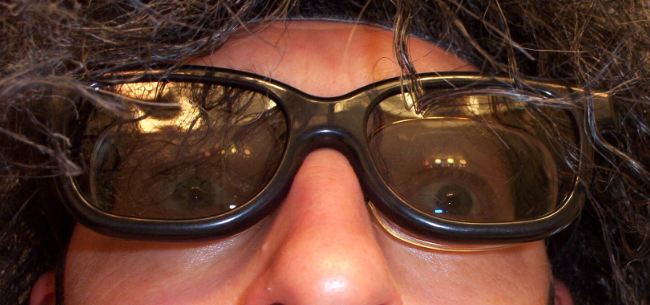
Now to get down to the nitty gritty of  this new (okay, new to me) 3D tech! The use of the new "REAL 3D" process on Resident Evil: Afterlife did, I can honestly say, add to my enjoyment of the film. How much did it add? I'd say perhaps 20% more. The action scenes were obviously the segments of the film that benefited the most from the 3D effect. When Alice leaps toward the camera, or throws objects at the camera, these things literally jump off the screen at you! The 3D also helped add depth to the long shots in the film; especially during the flying sequences over the desolate and ravaged cityscapes and landscapes. One thing the 3D process had trouble with were translucent objects. The plums of smoke rising from the ground in many of the scenes looked as though they were floating on their own plane and seemed out of sync with their surroundings. The only scene ruined by the 3D was the (thankfully) brief underwater scenes, where Alice and a few other are swimming through murky water-filled hallways beneath the prison. This scene was so blurry I briefly took off my glassed to see if it looked any better without them (it didn't). Speaking of the glasses: They had been a big concern of mine, because I do wear corrective glasses and I was worried that the 3D glasses wouldn't fit comfortably over them. Fortunately, the black plastic glasses are slightly over-sized and did fit easily over my corrective specks. Overall, the 3D experience was a good one and I would try it again in the future. But -- you knew there was a but coming -- the price for the 3D show was $11.00, which is nearly double what I pay for the matinee showing of the traditional 2D films. I think that if there was only a dollar or two difference in price, I might see even more films in 3D. However, until that time, I'll be seeing 3D only on special films that I think will benefit the most from the process.

There you have it! I give a wicked high recommendation to Resident Evil: Afterlife and a moderate, but still positive review of the new "Real 3D".


Tuesday, February 2, 2010

TO 3-D OR NOT TO 3-D: THAT IS THE QUESTION?

BY FRITZ “DOC” FREAKENSTEIN
I was chillin’ in the lab today, reading a national magazine (yes, I still get some of my genre news from old-skool paper pubs) and I read that 80% of Avatar’s $550 million domestic gross has come from 3-D ticket sales. Anyone who doesn’t know about James Cameron’s record-breaking science fiction film is not only living fifty feet under ground under a rock, but probably found this blog thinking it was dedicated to Gene Autry. Reading this made me recall a conversation that I had just last weekend with my fellow Genre Guardian, Professor Photon, about the recent glut of 3-D films being released. We had seen Avatar at the local cinema – in standard 2-D – partly because the theater didn’t show 3-D films, but also because I wouldn’t want to pay extra money for what I believe I referred to as “an optical gimmick that doesn’t work with my corrective-lens glasses on”. The Professor asked me what was the last 3-D film I had seen and I had to admit it had been a long time (they still used the paper glasses with the red and blue lenses). The Professor assured me that the new 3-D process was superior to the old one and that the newer plastic glasses fit just fine over his corrective lenses. The Professor also told me that I should support these technical advances in cinema projection, because in the future the virtual-reality-vision films were going to be even better! I told the Professor that as a time traveler I’d have to take his word for that, but in future I would attempt to seek out a screening of a 3-D movie: As long as it wasn’t a sequel to Friday the 13th or Saw.